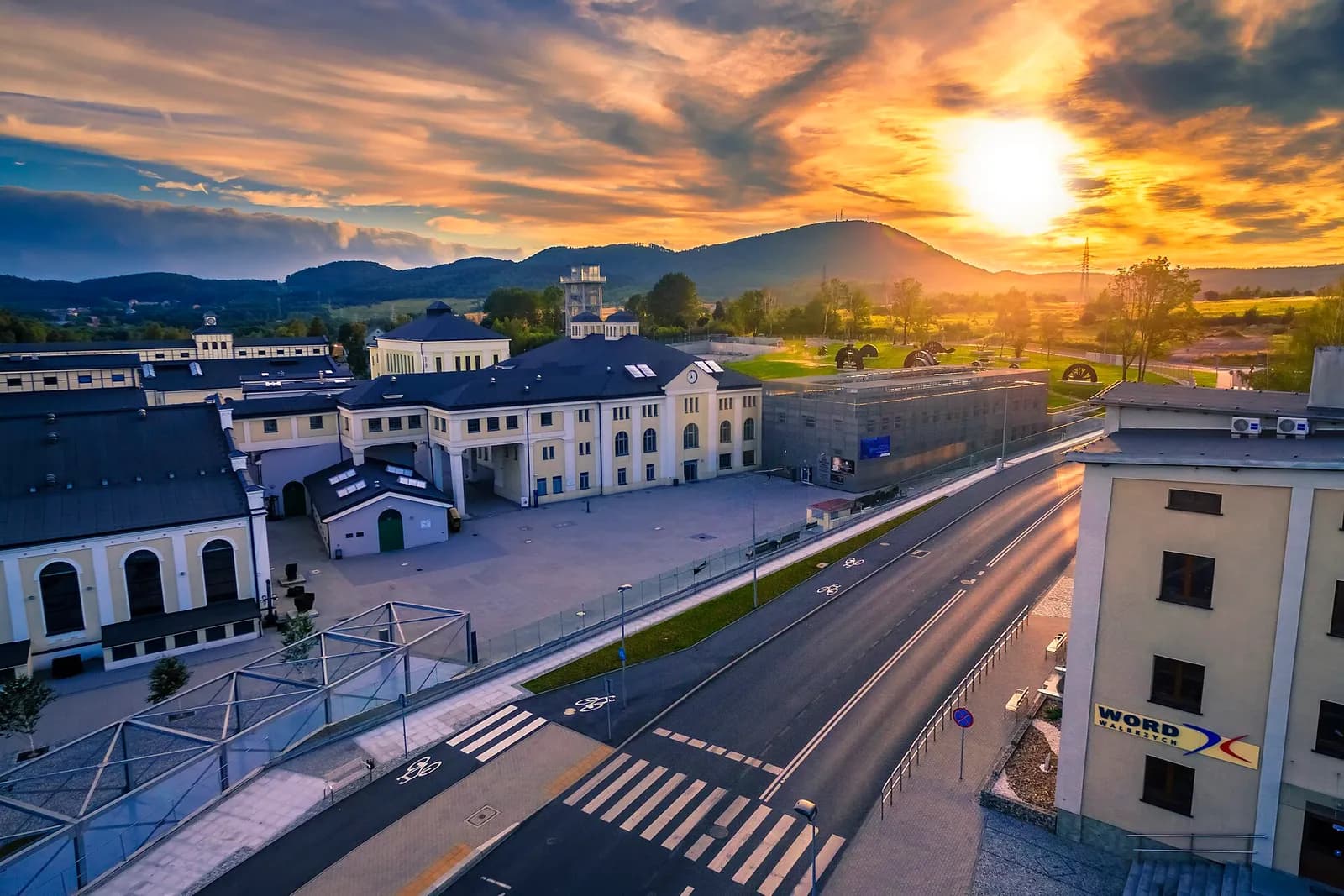
Wałbrzych’s industrial past is written into its landscape. Long after the last coal was brought to the surface, the towers, workshops and machinery of the former Julia mine still stand as a reminder of the industry that shaped the city.
Today, the site has a very different rhythm.
Known as Stara Kopalnia, the Old Mine Science and Art Centre, the former mine has become one of Wałbrzych’s most distinctive cultural spaces, bringing together industrial heritage, art, ceramics, science and events.
A mine with centuries of history
Coal mining in the Wałbrzych area dates back to at least the 16th century. The industry expanded under Prussian rule, with mining around Biały Kamień becoming increasingly organised during the 18th century.
In 1770, several workings were brought together under the Fuchs mining association.
One of the early landmarks was the Fuchsstollen, or Fox Adit, opened in 1794. The extensive underground passage provided access to numerous coal seams and was developed sufficiently for coal to be transported by boat.
By the 19th century, mining had moved deeper underground.
The Julius shaft, sunk from 1865, later became known as Julia. A second major shaft, Ida, followed in 1869 and eventually became Sobótka. Both remain part of the historic landscape visitors see today.
From Julia to Stara Kopalnia
After the Second World War, the former German mine became part of Poland’s nationalised mining industry. It was renamed Julia and later Thorez before the name Julia returned in 1993.
But the coal industry was already facing a difficult future.
The mine was declared bankrupt in 1990. On 20 September 1996, the last truck carrying coal left the site. Underground liquidation was completed two years later.
For Wałbrzych, the closure marked the end of an era.
The challenge was what to do with a vast industrial complex that had once employed generations of local people.
Preserving the machinery and the memories
The Museum of Industry and Technology was established in 1993, helping to preserve the mine’s buildings, machinery and equipment.
A major regeneration project later transformed the site into the cultural complex now known as Stara Kopalnia. The revitalised centre opened in November 2014, retaining the historic industrial character while introducing new cultural and educational uses.
That combination is what makes a visit particularly interesting.
The former bathhouse, lamp room, boiler house, workshops, shaft buildings and coal-processing facilities remain part of the experience. Mining machinery is still in place, while guided tours take visitors through the historic complex and its underground spaces.
Some guides also have experience of working at KWK Julia, bringing personal knowledge of mining into the story.
Art, ceramics and science
Stara Kopalnia’s story does not end with the museum.
The complex includes a contemporary art gallery and the Unique Ceramic Centre, reflecting Wałbrzych’s wider industrial and cultural traditions.
There is also SOWA, a science discovery centre designed around hands-on learning, alongside educational programmes covering science, mining, history, art and ceramics.
The result is an unusual mixture. Historic mining equipment sits alongside contemporary exhibitions, while former industrial buildings now provide space for workshops, family activities and cultural events.
Part of Europe’s industrial heritage
Stara Kopalnia became an Anchor Point of the European Route of Industrial Heritage (ERIH) in 2015.
That places Wałbrzych within a network of significant industrial heritage sites across Europe, connecting its mining history with the wider story of industrialisation, technological change and the transformation of former industrial cities.
For Wałbrzych, however, the history remains very local.
These are the buildings where people worked, the shafts through which coal was transported and the machinery that powered an industry central to the city’s identity.
A place still in use
Perhaps the most interesting part of Stara Kopalnia today is that it is not simply a preserved industrial monument.
The complex has an active programme of exhibitions, workshops, concerts, festivals and community events. Its large industrial spaces regularly take on new purposes, bringing people back into buildings originally designed for coal production.
That gives the old mine a presence in contemporary Wałbrzych rather than leaving it solely as a reminder of the past.
The industrial story of Wałbrzych
A visit to Stara Kopalnia offers a glimpse into the Wałbrzych that existed before the mines closed, while also showing how the city has found a new use for this remarkable piece of its industrial landscape.
The coal has gone, but the mine remains.
Its towers still dominate the skyline, its machinery tells the story of generations of work, and its buildings now provide space for culture, education and events.
For anyone wanting to understand Wałbrzych beyond its better-known attractions, Stara Kopalnia is an essential place to begin.
See more: Porcelain Museum in Wałbrzych: A Journey Through Silesian Heritage
Image credit: Tomasz Góra, Wikimedia Commons, CC BY 3.0